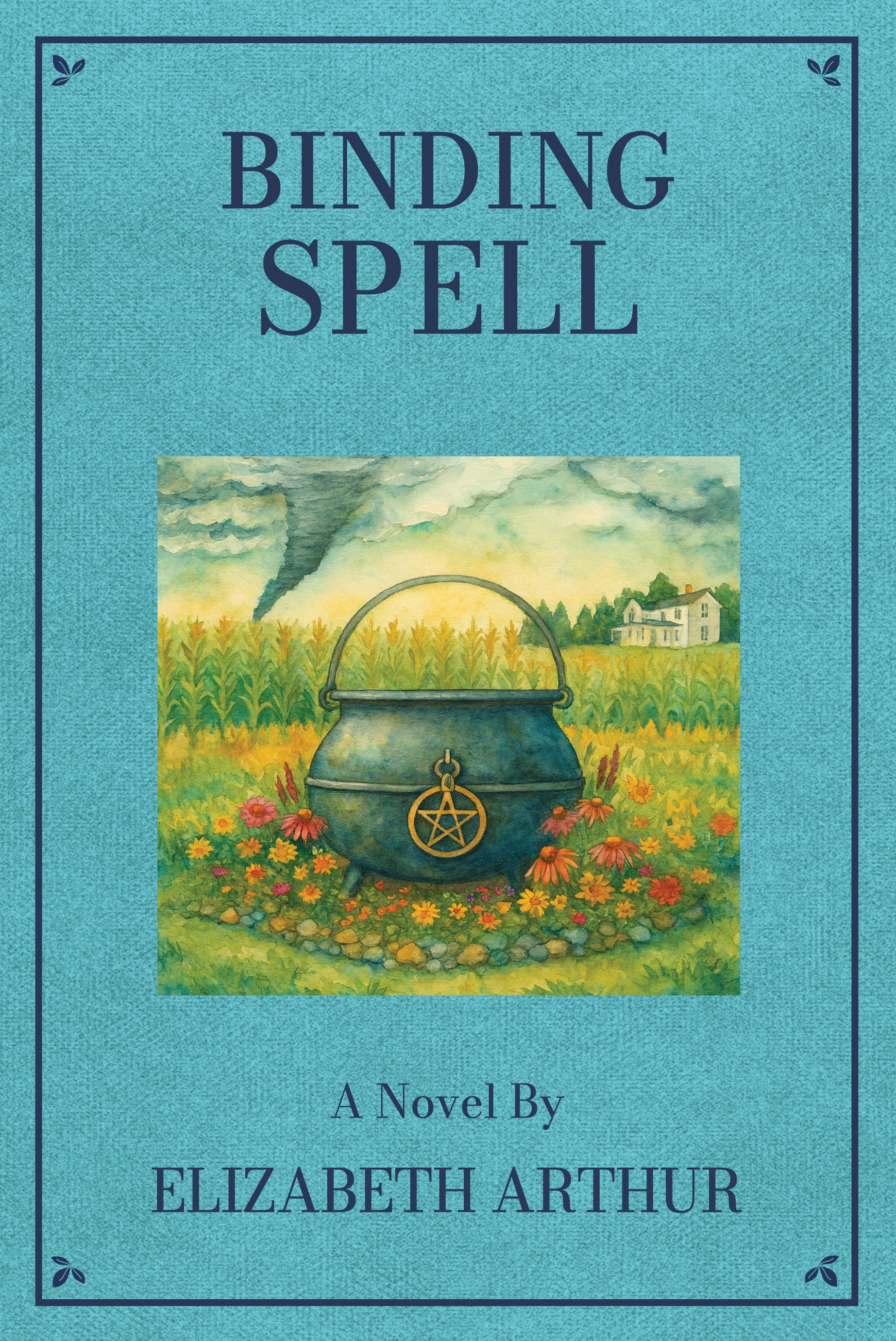
Binding Spell
Foreword By Steven Bauer

A SMALL-TOWN FABLE OF TRANSFORMATION, MYSTERY, AND UNRULY MAGIC
Foreword to Binding Spell
In mid-June of 1982, Elizabeth Arthur and I left Waterville, Maine where I had been teaching at Colby College, and where Liz had been living with me for eight months. We were on our way to Vermont, where we would shortly get married. After our wedding, we would head to Wyoming for a backpacking trip in the Wind River Mountains as a honeymoon.
But along the way, we stopped in Oxford, Ohio where I would begin teaching at Miami University in the fall. We had not yet found a place to live in Oxford, and we spent a week there looking. Meanwhile we were trying to get used to the Midwest, which looked ordinary enough but was strange in various ways - its weather, its landscape - to two people who had been born and raised in the eastern United States.
There are various terms for this geographical area - one of the most condescending of which is “flyover country.” For Liz and me, the Midwest had always seemed more like “drive-through” country, as both of us had rattled back-and-forth between the east and west in automobiles and trucks, in the years before we met. My destination had generally been California, Liz’s Wyoming or British Columbia. But now we were no longer simply zipping through the landscape. And for Liz, the prospect of spending years in a town in southwest Ohio did not sit well at first for someone used to mountains and islands.
We spent a year living in our rental in Oxford and then in the spring, with the help of a colleague, we found an old falling-down farmhouse in the small town of Bath, Indiana - just across the state line. A Queen Anne Victorian in style, and built around 1910, the house was due to be demolished by the farmers who owned the land on which it sat and who were planning to plant corn where it stood. We begged them to let us buy it. They thought at first we were joking.
That late spring and early summer we worked 12-to-14-hour days, beside the tradesmen we had hired, to try to put the house in some kind of livable shape. Our deadline was August 1 and we met it. And then the years began to roll by as they do in the Midwest. Under our hands our almost-two-acre parcel became an oasis, a place of true peace and tranquility. We loved our little bit of the planet, and if we didn’t love everything else about the Midwest, we got used to it in time.
Except for the tornadoes. I’d been through hurricanes and tropical storms, but this was something else again, materializing suddenly out of the sky, demonic, illogical, and very specifically targeted. When I was growing up in New Jersey, I could never have imagined I would one day need to have a NOAA Weather Radio or would check the National Weather Service forecast incessantly when the western sky got glowery.
There were advisories and watches and warnings. We had a routine - closing the blinds and curtains against shattering glass, huddling near the cellar door with the dogs. On Good Friday of 1986, I was at my desk and Liz was upstairs resting. The sky was dark; I was determined not to get paranoid. Until Liz came running downstairs telling me to for god’s sake get the dogs and myself into the cellar. Outside my study windows the air was blue-black. The rain was falling upwards. Some of it was pounding against the windows and geysering up between the window jamb and the sill.
We made it to the cellar with the dogs. But the funnel passed very close to us, destroying our neighbor’s barn about a quarter of a mile away and taking out the mobile home cattycorner to it.
It was about this time that Liz conceived of a comic novel set in our new landscape. Russia-phobia was in the air along with interest rates and tornadoes. Liz had become interested in Wicca through reading a book by a woman named Starhawk. She set the new novel in the fictional town of Felicity, which was based in many particulars on the nearby town of Liberty, Indiana. As she had in Bad Guys, Liz chose a revolving cast of third-person narrators.
But whereas the six narrators in Bad Guys spun their relationships with one another as the book progressed, all three of these pairs were familial, with all the baggage that entails - history, envy, longing, frustration, loyalty, and love. There are glimpses of Liz and me in the characters of Maggie Esterhaczy and Ryland Guthrie - I’ve been known to be hypochondriacal, and as a child, Liz believed there was a link between radiators and radiation. Believe it or not, the Beyond War meeting Ryland and Maggie attend in these pages is an act of sober reportage. Everything that happens, everything that is said at the Reverend Wickenden’s, was actually said, and actually happened, right down to the BBs.
The other four characters are also based loosely on people we knew. Our next-door neighbor, whose barn was ripped so rudely from its foundation, became the character Howell Bourne. Bailey and Peale were both based on old friends of Liz’s. And Ada! I never met her in the flesh, but I certainly met Liz’s Hungarian grandmother on the page. God also makes a number of memorable appearances.
The plot proper revolves around two Russian professors who are invited to visit the local college and the uproar that causes. Though the novel does not specify and Ronald Reagan isn’t mentioned, this was the time of the Evil Empire - before the Berlin Wall fell and the Soviet Union dissolved, and long before Vladimir Putin assumed the role of World Villain.
As well, the mid-1980s was a time of unparalleled inflation and rising interest rates; people who had variable loans were in serious trouble, and farmers were feeling the pinch. So Howell Bourne, a farmer himself, an endlessly curious man with a penchant for conspiracy theories, takes it upon himself to save the day. He will kidnap the Russian professors, and his ransom demand will be the burning of the mortgages in Rock County.
The inciting idea may be zany, but to us in our Midwestern farmhouse not as odd or strange as it might seem to other people. Jehovah’s Witnesses regularly knocked on our back door; unseen people left pamphlets wedged between the screen door and the jamb. It was all too easy to imagine one of our neighbors concocting a plan such as Howell’s.
Our neighbors, of course, were reasonable people when they weren’t being religiously inflamed or politically misinformed, and aside from his fixation on the mortgages and on Russia, Howell is a genial if confused man who tries to think hard about the world and his place in it. He is far from the stereotype of the Midwestern rube.
And if Howell is responsible for throwing the plates in the air, it is Ada Esterhaczy who juggles them. Her cheerful narcissism, her disdain for rules and regulations, her endless enthusiasm for the life she has been given, and her double plan to get both her hound, Boonskie, and her granddaughter, Maggie, pregnant creates much of the novel’s humor and action.
The Russian professors are an unwitting comedy team in themselves, out of Burns and Allen or Laurel and Hardy. They delight in all things American, from its diction to its card games, and Ada, who hates all Russians - indeed the very idea of Russians - is so charmed she tries to get them to defect and move to Indiana. Along the way love blossoms and by the end we have what can only be called a Shakespearian comedy with an imagined double wedding.
Unlike Bad Guys where the comedy lies mostly in the tone and the language, in Binding Spell the comedy lies also in the fact that funny things happen. Ada pretends to go to church so that Maggie and Ryland can properly meet each other; the Beyond War meeting is both tragic and hilarious; Bailey tries to establish a coven with predictable results; the tornado picks up an overstuffed chair and deposits it unharmed on Ada’s rooftop; the kidnapped professors play Indian poker; Peale despairs of his job as a sheriff, and then takes it up again as a real responsibility.
But it is the slow awakening to the complex uncomfortable feelings of attraction and lust on the part of the two couples - long after we are well aware of where they are headed - that causes a great deal of comedy as well. Binding Spell is without question Liz’s sunniest novel, and I love it. I can open it to any page and begin reading, immediately lost in a world that is realistic and fantastic at once.
Aside from the six point-of-view characters whose lives and loves take up most of the book, its spectacular ending goes to one of the dogs, Ada’s magnificent hound-cross Boonskie. Throughout the book, the dogs are real dogs with real personalities and a real bearing on the plot. I know these dogs well, because I lived with them for years and loved them all fiercely. The book is dedicated to them. They are all gone now, but they live on in Liz’s heart and in mine, and in the pages of this wonderful novel.
S.A.B. 2025
“Binding Spell is a very funny and exceedingly well-crafted comic novel... Elizabeth Arthur asks what life would be like if it were true that our wishing for happiness – our working for it – negated misery and brought contentment into existence. Life would be, as Arthur demonstrates, wonderful, unpredictable, and above all, funny.” ~ Chicago Sun-Times
“Like an offbeat, modern fairy tale...(a) funny and moving story. After a wonderful climax during which a tornado wreaks havoc in Felicity, the characters variously achieve passion, happiness, and balance. A tale full of wit and affection, Arthur’s latest offering (after Bad Guys and Beyond the Mountain) also boasts the best collection of dogs in recent literature.” ~ Publisher’s Weekly
“Wonderfully benign and satisfying...as appreciative and good-natured as one of Shakespeare’s merrier comedies – the ones in which the irrational acquire some common sense and the rationalists learn to have a jolly time.” ~ Washington Post
“A Midwestern Midsummer’s Night Dream.” ~ Kirkus