
From Steven Bauer
AN ANNOUNCEMENT
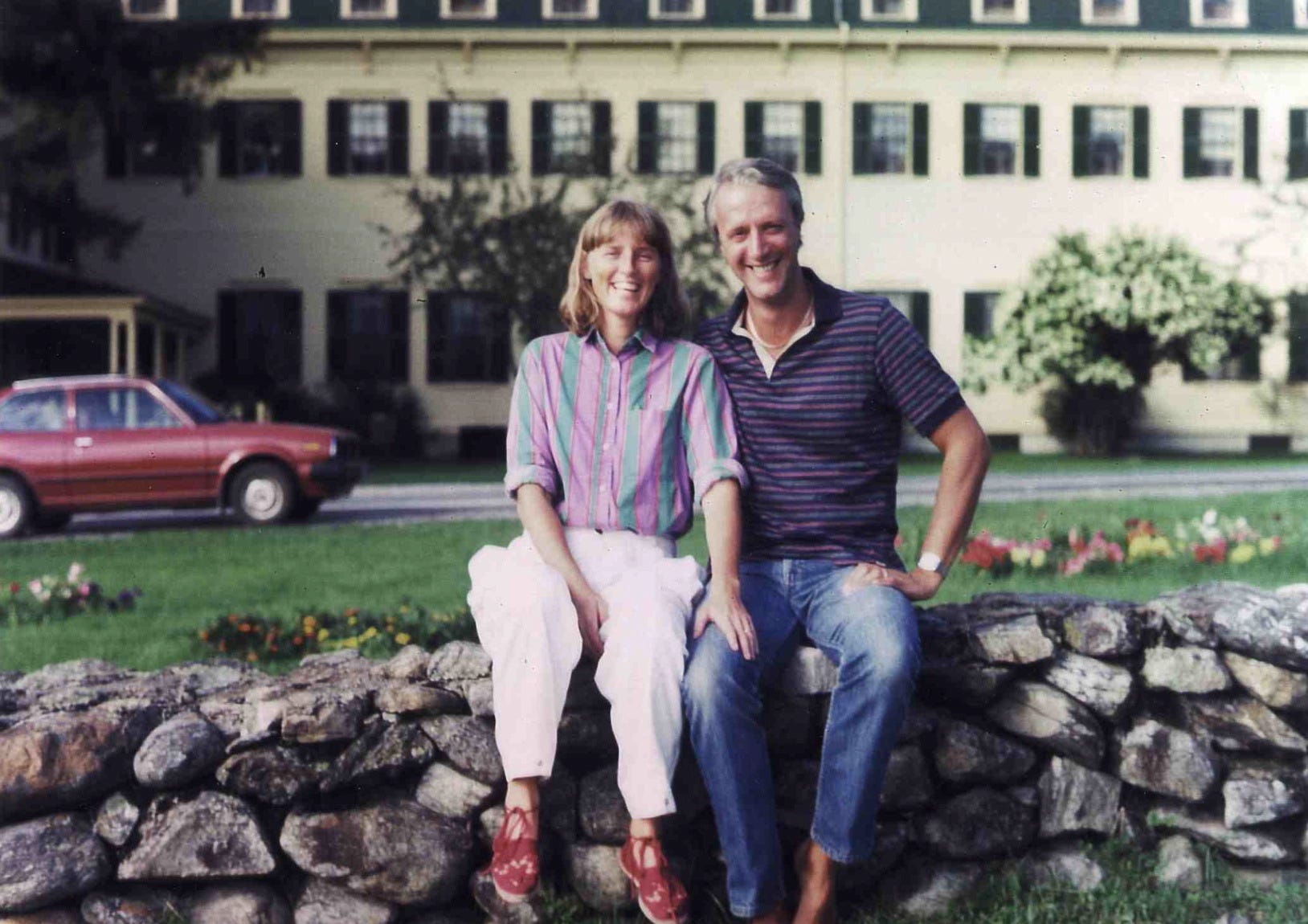
Elizabeth Arthur and Steven Bauer in front of the Inn at Bread Loaf, 1985
To: All Friends and Fans of the Three Investigators Series
From: Steven Bauer
It was one of the great pleasures of my life to collaborate with my wife Elizabeth Arthur in the writing of the new Three Investigators series. Since Liz originated this newsletter, just as she originated the books, she’s been the one who’s written and sent out these posts.
Meanwhile, I’ve been busy behind the scenes with the details that come with publication - final edits, copy edits, getting files formatted, uploading files, etc. But it’s now time - at least for a short time - to let you hear directly from me about how the books got written.
As most of you know already, although Liz had any number of opportunities to sell the rights to the original Three Investigators series to Hollywood, she decided against that, once and for all, when a producer she was working with in early 2018 had a pitch meeting with Netflix and Netflix’s representatives told him they’d be interested in the project if they could turn Jupiter, Pete, and Bob into girls.
That was it for Liz: it brought home to her as nothing else could have that no good could possibly come of any avenue to a Three Investigators future that involved Hollywood. Though she’d long wanted to find a writer she could trust to write new books – updated for the current age but still true to her father’s universe – only after that Netflix meeting did it occur to her that we were writers, and that the best way to get good new books into the world might be to write them ourselves.
In late November of 2018, she and I were having dinner one night when she proposed we do that, and I said yes. That very night, Liz came up with the central organizing principle - that the books we wrote would be, essentially, Bob Andrews’s write-ups of the new cases, and in the first book it would be Bob’s idea to catch the attention of prospective readers by using alliterative alphabetical titles. Both Liz and her father loved alliteration (Jupiter Jones, anyone?) and the unexpected match-up of an unusual adjective and more familiar noun would act as flint and steel to ignite a fire in Liz’s fertile imagination.
There would be twenty-six books. Soon Liz was at work, scouring lists of adjectives and nouns, and very shortly she had a list she found intriguing. (The list changed dramatically over time.) She also decided that each adjective-noun pairing would be a metaphor - in the creation of which she has few equals - and that each metaphor would embody and illuminate the book’s theme.
So we began as we would continue. Liz brainstormed the plots, with the titles as inspiration and little help from me – except when I gave her a bad idea she could work against! She wrote detailed notes about what would happen in each book, chapter by chapter. She gave me the notes and I turned them into prose, researching as I went along, writing the first cohesive continuous draft (and coming up with most of the jokes.)
Then I gave the manuscript back to Liz, who rewrote it as necessary, often completely revising the first and last chapters to make sure the books started well and to wrap them up in a convincing and satisfying manner. Then back to me for a line edit, further rewrites, and copy-edit. Then back to Liz to double-check everything and print off a penultimate draft.
All this work had been done on computers. But with a paper copy, I sat down once more for a final line and copy-edit with a trusty pencil. Then back to Liz, who mastered the file and created a PDF that I then sent off to the amazing professional who has formatted all the uploadable files for the classic and new Three Investigators series.
Twenty-six times in seven years.
It’s been a lot of work, but also a great deal of joy. Jupiter, Pete, Bob, and Mallory are very real and very dear to us.
Through it all, Liz has been the final arbiter, the keeper of the flame, the ingenium praesidens. Though we co-wrote the series, she was the creator, as well as the person who managed to keep in mind how twenty-six separate books could be placed one after another in order to tell one continuous and consistently evolving story that took place over four years. Of all the many talents she brought to this project, that, to my mind is the most astonishing.
Of course she’s had a lot of practice. Over the years she’s written six novels and three memoirs. I fell in love with Liz’s writing before I fell in love with her; in fact it was her writing that introduced us forty-five years ago. Her books have been out of print for some time, except in a scattered set of e-book editions, or through sales of old or used hardbacks and paperbacks.
However, last Saturday – on March 14th – Liz’s first two memoirs and her first four novels were re-issued through Hollow Tree Press in a Collected Works edition. The books are now available again to a large audience – of which I fervently hope that subscribers to The Salvage Yard will be a part.
There are few writers who have written such consistently wonderful, engrossing, crucial books - books that are both a joy and pleasure to read and that both matter and linger in the mind. Liz asked me to write Forewords to the books, to put them in a kind of context, to show how and where and maybe even why they were written, and it was an honor for me to do so.
Along the way I also used them to tell our story, and to try to make clear and understandable the extraordinary person Liz is.
I decided to wait until today to post this announcement, because I wanted to wait until the weekend to post the Forewords I wrote to the six books. Since each Foreword is about four book-pages long, and since each is very different from the others, I’ve decided to publish each of them in a different post, but to post all the posts at the same time tomorrow – a Sunday.
I’ll be labeling each post with the name of the book, and including an image of the dust jacket. Please consider the six separate posts to be, essentially one post – a post which has been broken into six pieces for easier reading - and please feel free to read all of them, some of them, or none of them, depending on your preferences.
Since I realize that everyone gets far too many deliveries in their in-boxes every day, and not all of you will necessarily have the time to read all of the Forewords in the coming days (though I hope you will!), I thought I’d give you a preview of each of the books right now, so that if you can’t read all of the posts when you get them, you can at least read the ones for the books that seem to match your own reading interests best. Here goes, then:
Island Sojourn was Liz’s first book. It’s a memoir. When she and I were both at the Bread Loaf Writer’s Conference in 1980, I heard her read a small section from it, but it was only after I went back to Maine, where I was teaching, that I read the whole thing. Liz jumped from the pages - someone intrepid enough to leave the U.S. and become a landed immigrant in Canada; someone adventurous enough to build a small home by hand using hand tools on an electricity-free wilderness island in a wilderness lake; and someone clear-eyed and observant enough to write about the experience in a way that let the reader experience it too.
Beyond The Mountain was Liz’s first novel. Liz had already written a draft of it before we started living together in the fall of 1981. The book draws its immediacy, vivid detail, and emotional intensity from her trip to Nepal and from the break-up of her first marriage, which occurred between when we met in August 1980 and the following year. I remember reading the book’s climactic scene in her house in Vermont – just two weeks before she moved to Maine to be with me – with a sense of utter astonishment. I’ve read the novel several times since and it’s lost none of its power.
Bad Guys was written after Liz and I were married, but it was still a wonderful surprise. Liz holds her writing close until a draft is finished, and though she talked to me about it while she was working on it, and made enigmatic comments concerning it, she doesn’t like to part with information until she has something totally solid to show. This flies in the face of the habits of many writers – who seek responses and reassurance before they’ve finished even the first chapter. Since Island Sojourn and Beyond the Mountain are both quite serious in their tone and their intentions, when Liz finally gave me the opening pages of Bad Guys and I found myself laughing out loud, I knew Liz was writing in a different key.
Binding Spell was written a number of years after we’d moved to the Midwest, where I’d accepted a teaching job. As someone who’d spent her life in the mountains of Vermont and the far more imposing mountains of the American west, Liz was quite leery about a move to southwestern Ohio. But the year after we moved there, we found a broken-down, barely salvageable 1910 farmhouse just over the Indiana border on the edge of miles and miles of plow-land. It was all we could afford, and we brought it back from the brink and turned it and the just-under-two-acre parcel of land it sat on into an oasis. Binding Spell – which is even funnier than Bad Guys and which lacks its darker tonalities – will give you a sense of the Midwest’s joys and contradictions.
Looking For The Klondike Stone was Liz’s second memoir. I defy anyone with a pulse to read this book and not be mesmerized by it. In it, Liz remembers with a vividness of detail that is almost unbelievable what it was like to be a young girl at a summer sleep-away camp in the Green Mountains of Vermont. It is here that she takes her first camping trips and learns her first woodcraft, and it is an amazement to see the formation of the young girl who will become the young woman who moves to a wilderness island in Island Sojourn.
Antarctic Navigation is a masterpiece of late-20th-century American literature. It’s the book for which Liz is most widely known, and with good reason. It is long, and rich in emotional, psychological, and physical truth, wildly ambitious in scope, and with breathtaking evocations of the landscape of Antarctica to which Liz traveled in the austral summer of 1990. It’s prescient in its analysis of the need for a new way for humanity to navigate the future. And it has a female hero unlike any other. In fact, when I think of other contemporary books to compare it to, I can’t come up with any. As Publisher’s Weekly put it, it’s “a triumph of the novelist’s art.”
Liz has also finished three other books - two novels and a third memoir - which are not yet included in her Collected Works, because we haven’t yet decided how best to publish them. One of the novels is called The Lay of Gilgamesh and is a revision of a novel called Bring Deeps which was published by Bloomsbury UK in 2003. The other novel is called The Forest of Katyn and is a kind of bookend to Antarctic Navigation - a vast and wonderful novel that took Liz almost twenty years to finish. The new memoir was finished just last month, and will be, in part, the subject of a future post from Liz herself.
I’m looking forward to sharing my Forewords to Liz’s Collected Works with you. I hope you’ll buy the books and read them. I hope you’ll talk about them on social media. I hope you’ll tell your friends. No need to keep them a secret any longer. They’re a great important addition to American literature.
Thank you for being here, and for reading along with me at last.
Steven Bauer